Alvin Toffler in his 1970 blockbuster, Future Shock, wrote; "The great growling engine of change is technology,"
Toffler, a frequent visitor to the region and a key influence on its modernization, saw Hong Kong as a living laboratory for the future.
He understood that the faster a society moves, the more "shocked" and resistant its people become to new paradigms.
1. The Myth of the "Static" Grid
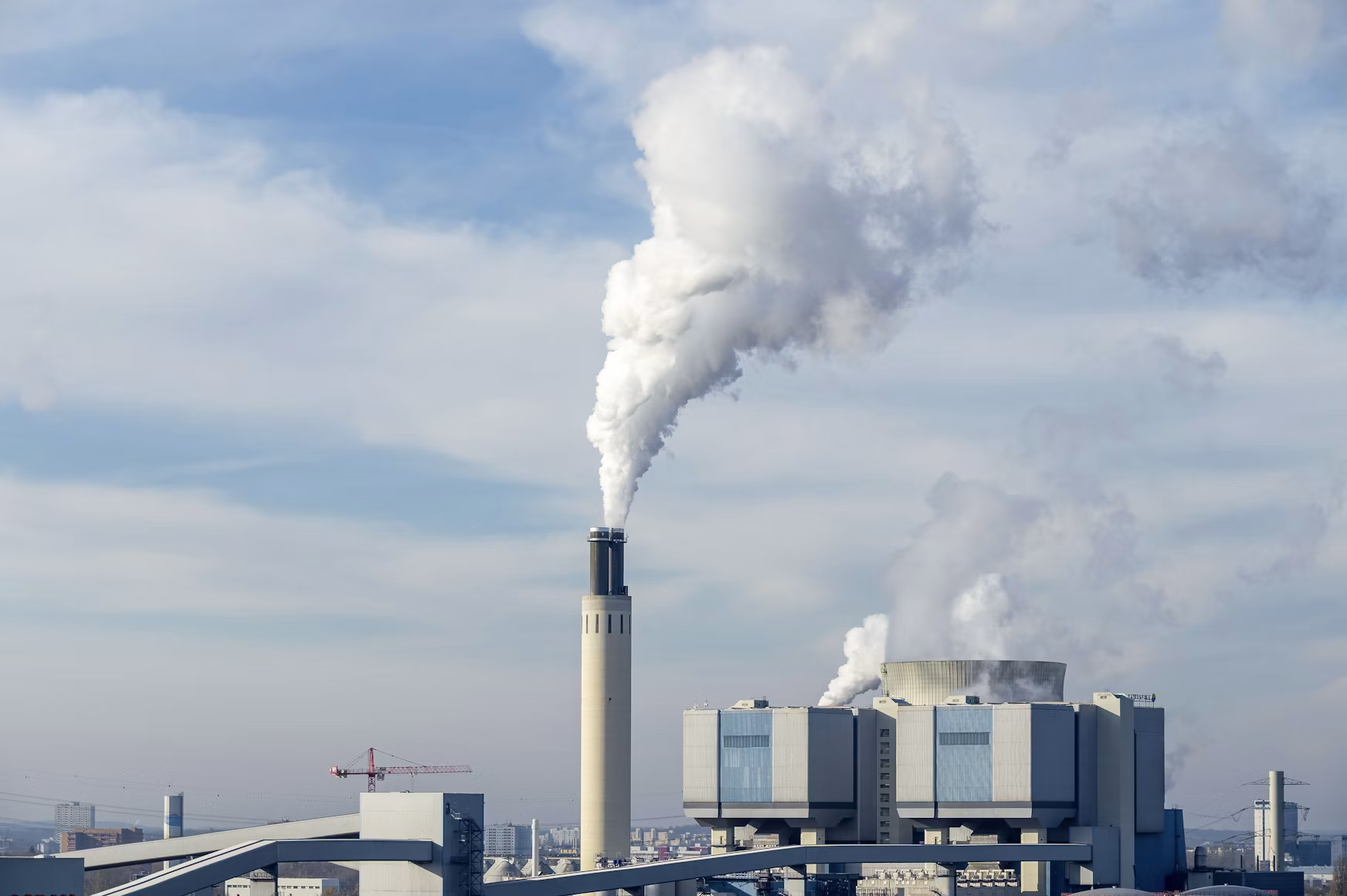
Critics argue that an EV is only as clean as the power plant that charges it.
If that plant burns coal, they claim, you've simply moved the pollution from the street to the smokestack.
However, this ignores the bigger picture: Hong Kong's grid is a moving target. Toffler's "engine of change" is currently dismantling the coal era.
- The Shift: CLP and HK Electric have already transitioned the majority of their generation to natural gas and zero-carbon energy.
- The Future: Under the Climate Action Plan 2050, coal is being phased out for daily use entirely by 2035.
Unlike a petrol car, which stays just as dirty as the day you bought it, an EV gets cleaner every year as the grid evolves. As the late Anthony Bourdain said of our city, "You don't need to know where you're going-you just press start." Buying an EV today is "pressing start" on a machine that automatically decarbonizes over time.
2. Efficiency: Why Coal-Power Still Beats Petrol
Even if our grid were still dominated by coal, the "coal-burning car" label fails the physics test.
- Internal Combustion Engines (ICE): Only about 20% of the energy in a tank of gas actually moves the car. The rest is wasted as heat-literally burning money for nothing.
- EV Drivetrains: They are over 85% efficient.
Even a coal plant-centralized, industrial, and highly regulated-is far more efficient at converting fuel to energy than a thousand tiny, unmaintained engines idling in Central or Tsim Sha Tsui traffic.
3. The "Dirty Battery" and the Bigger Picture
The most common "gotcha" involves the bigger picture of energy used to make and dispose of batteries. It is true that mining lithium and manufacturing packs creates a "carbon debt" at the factory gates.
But by 2026, that debt is paid off faster than ever. In Hong Kong, an EV typically hits "carbon parity" with a gas car after roughly 2 years of driving.
Closing the Loop
The idea that batteries end up in a landfill is wishful thinking for critics, but a solved problem for 2026 engineers:
- Second Life: "Old" EV batteries are being repurposed as stationary storage for the HK grid, helping store renewable energy for nighttime use.
- Recycling: Local facilities now recover over 95% of critical minerals (Lithium, Cobalt, Nickel) from retired packs, turning yesterday's cars into tomorrow's batteries.
The "coal-burning" narrative is a distraction from a much more urgent reality. This was perhaps best understood by James Tien, the textile scion and former Chairman of the Liberal Party and the Hong Kong Tourism Board.
Tien, a veteran pro-business lawmaker with deep roots in the city's manufacturing and commercial sectors, famously noted that air pollution in Hong Kong is not just a scientific metric; it is a "health issue, a lifestyle issue, a tourism issue, a business issue, and increasingly a political issue."
Coming from one of the city's most prominent pro-business voices, this wasn't environmental activism-it was economic survival. Tien understood that if the sky stayed grey and the streets stayed choked with fumes, Hong Kong would lose its competitive edge as a global destination.
To call EVs "wishful thinking" is to ignore the progress of the last decade. In 2026, the data is clear: the "engine of change" is electric, and the only wishful thinking is believing we can stay parked in the "Second Wave" of the past.
Technical Sidebar: Industrial vs. Tailpipe
| Feature | Your Car's Catalytic Converter | HK Power Stations (Lamma / Black Point) |
|---|---|---|
| Maintenance | Subject to owner neglect; degrades over age. | 24/7 Professional monitoring by engineering teams. |
| Nitrogen Oxides (NOx) | Limited reduction; ineffective during "cold starts." | SCR Units: Uses ammonia to convert NOx into harmless nitrogen/water. |
| Particulate Matter (PM) | Soot is emitted directly into urban canyons. | Precipitators: Pulls 99.9% of ash and dust out of the exhaust. |
As James Tien once noted, air pollution is a "health issue, a lifestyle issue... and increasingly a political issue." In a city as dense as ours, roadside nitrogen dioxide (NO2) levels are a direct threat to public health. EVs eliminate this local "tailpipe" problem instantly.
Conclusion
The claim that EVs are "coal-burning cars" is a distraction from the real "Future Shock" we face: the need to adapt or be left behind.
As Prince Charles once remarked, "Hong Kong has created one of the most successful societies on Earth."
Keeping it that way means leaving the coal-burning myths in the rearview mirror.